Mass Ave and the Monon: The City Recycling Itself
A bottling plant reborn as a hotel, a railroad reborn as a trail, a diagonal drawn in 1821: Mass Ave and the Monon are Indianapolis's recycling program at city scale.
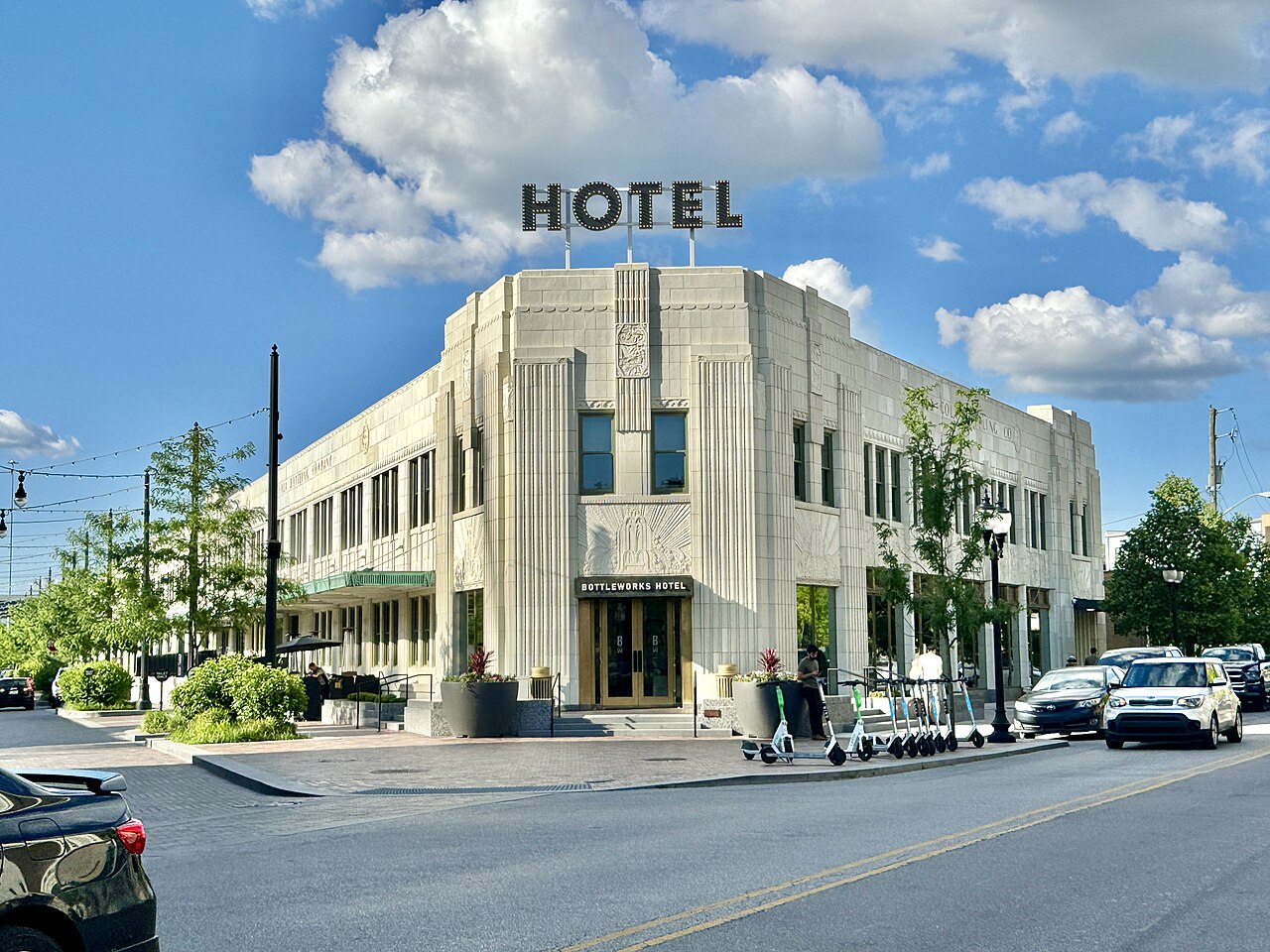
Massachusetts Avenue is one of Alexander Ralston's diagonals — a street slashing out of the mile square at forty-five degrees — and it has become Indianapolis's most complete lesson in how a city recycles itself. The avenue's old commercial blocks, written off in the freeway decades, now hold the theater district's second act: restaurants and bars in nineteenth-century storefronts, the Phoenix and Old National theaters, and at its head the Bottleworks District, where the city's great Coca-Cola bottling plant — an Art Deco palace of terra cotta — has been reborn as a hotel, cinema, and food hall.
The Bottleworks is the parable's punchline: a 1930s industrial landmark, the largest Coca-Cola bottling plant in the world in its day, saved not by freezing it but by filling it — its machinery halls now a movie palace's lobby, its bottling lines' spaces given to kitchens and a hotel whose design treats the Deco inheritance as the luxury it always was.
North along the Monon Trail, the other great recycling runs on rails. The Monon — the old Monon Railroad's line to Chicago — is now a greenway running from downtown through Broad Ripple to Carmel and beyond, some twenty-five miles of the region's most-used trail, carrying commuters and weekend caravans through the city's north side. Broad Ripple Village, where the trail crosses the White River, is its capital: a former independent town, annexed a century ago, that keeps a village's scale and a college town's nightlife, its 1920s amusement-park grounds now the riverfront park.
The two corridors together describe how Indianapolis actually grows in this century: not outward first, but back into its own bones — a bottling plant into a hotel, a railroad into a trail, a streetcar suburb into the city's front porch.
November walks well on both: the avenue's dining rooms against the early dark, the Monon's last color under the maples, Broad Ripple's patios yielding to its fireplaces. Ralston drew the diagonal in 1821 for a capital of horsemen. It is serving cyclists and theatergoers now, on the same line, at the same angle.